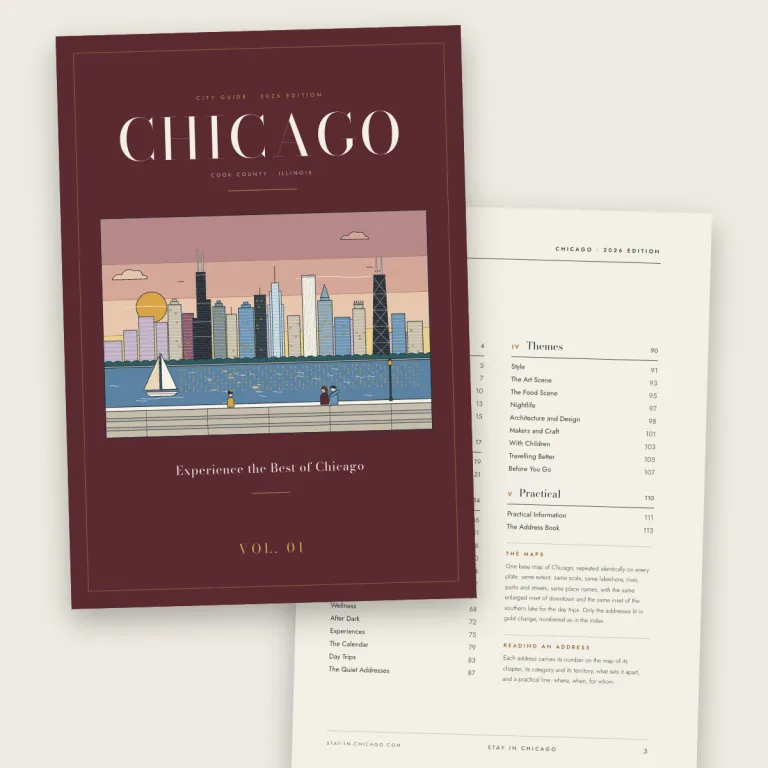
Chicago looks simple on a map: a grid, a lake, a river. Trips still go wrong on one point, the hotel. Booked two miles from the river, it turns every evening into a taxi ride; booked in the right band, it puts the architecture boats, the Art Institute and dinner within walking distance. The Chicago City Guide, our 2026 edition, starts from that question. It reads the city territory by territory, and for each one it answers what matters: stay there, or just visit?
What is inside
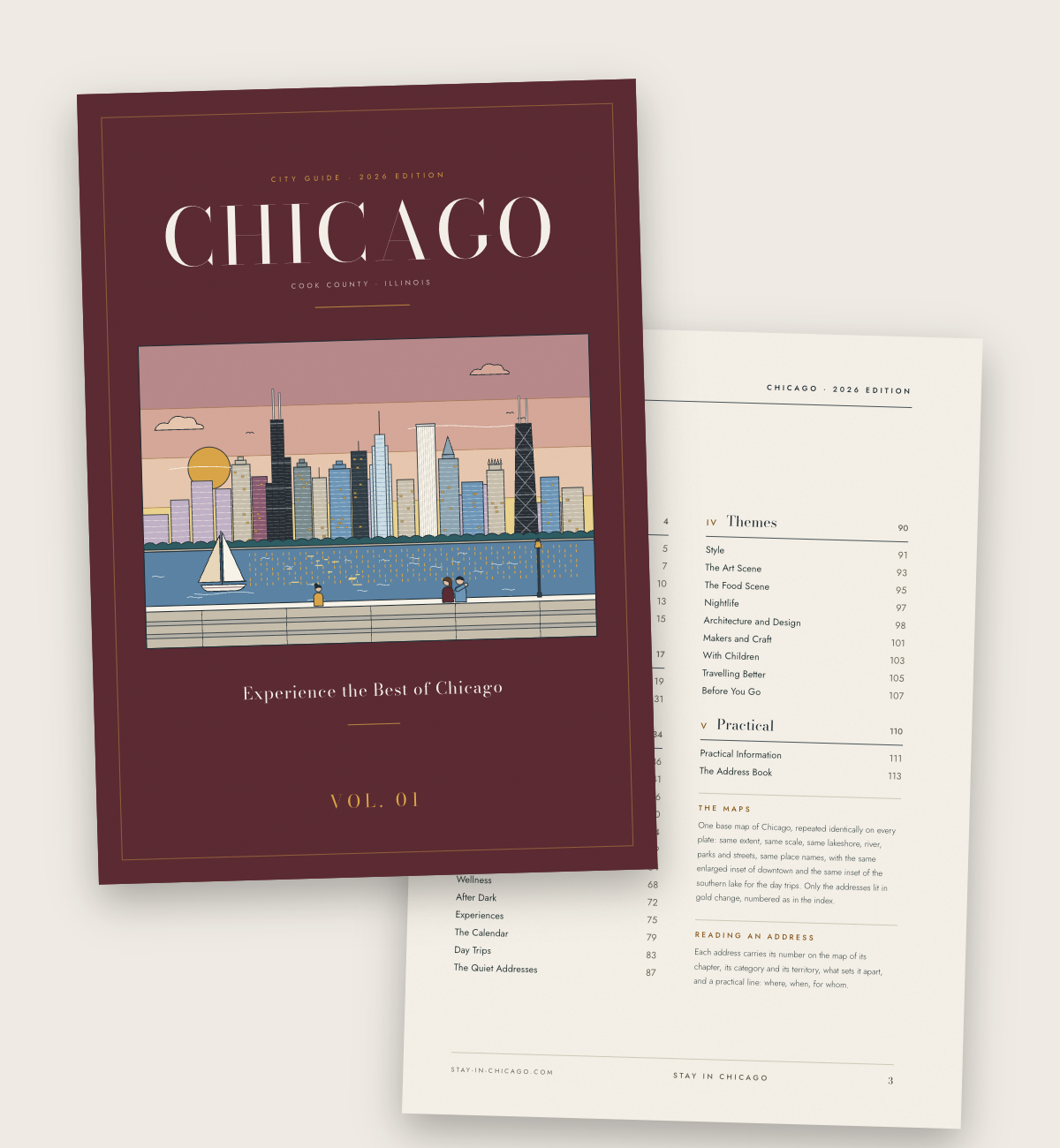
115 plates. 102 numbered addresses, from a 21-seat room beneath The Aviary to a 1908 glasshouse by Jens Jensen on the West Side. 22 maps. 30 illustrations. Three itineraries. Five parts: the opening, the territory, the address book, the themes and the practical section.
The address book is the core of it: 10 places to stay, 12 to eat, 8 to drink, 6 for coffee and early hours, 10 for shopping, 10 for culture and heritage, 8 outdoors, 5 for wellness, 6 after dark, 8 experiences, 8 dates in the calendar, 6 day trips and 5 quiet addresses for readers who already know the city.
Eight territories, from Lincoln Park to Hyde Park
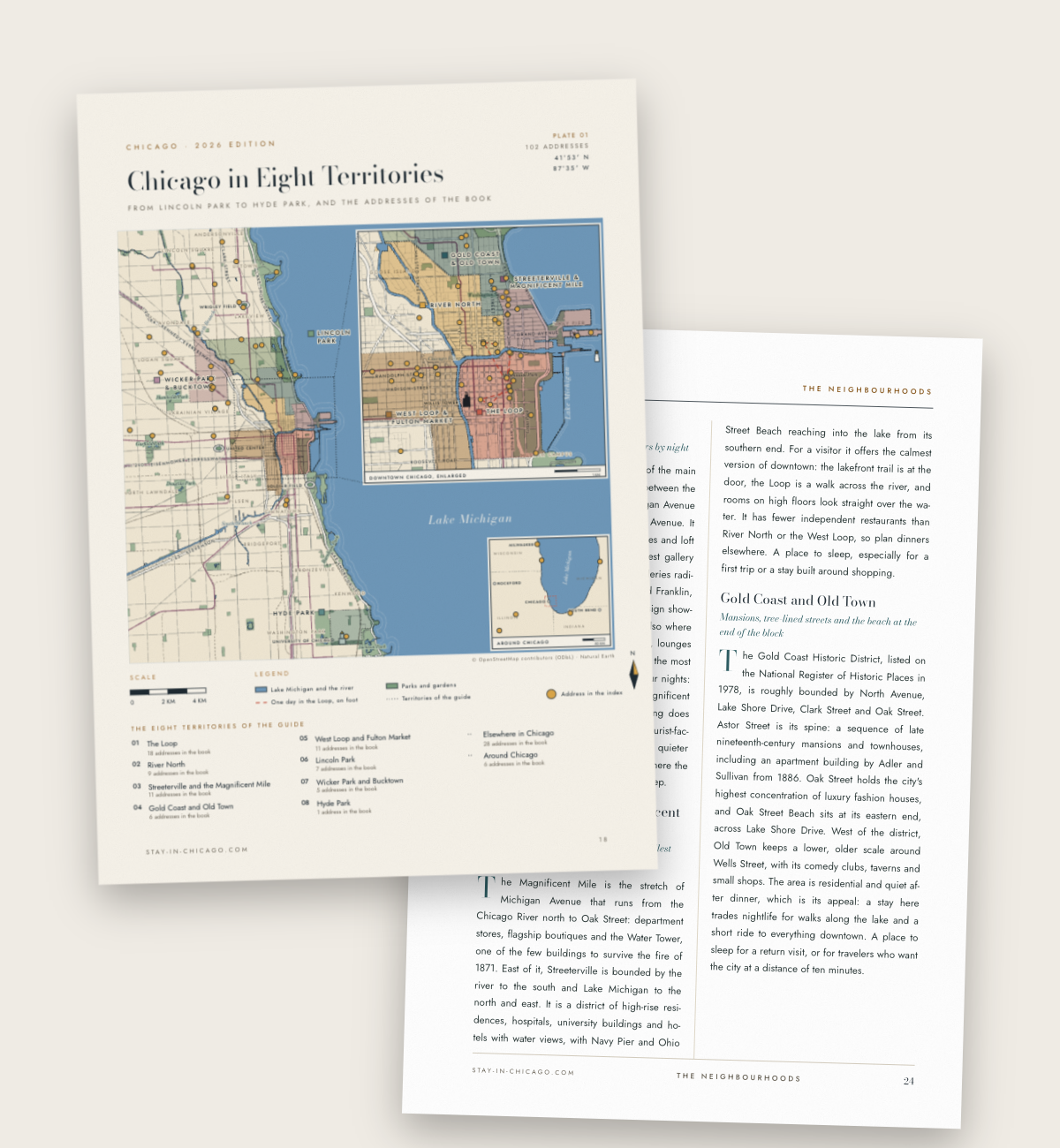
The guide divides Chicago into eight territories. Around the river: the Loop, River North, Streeterville and the Magnificent Mile, the calmest version of downtown, and Gold Coast and Old Town, with its mansions on Astor Street. West and north: the West Loop and Fulton Market, the former meatpacking district that became the city's dining address; Lincoln Park, its zoo and its Victorian side streets; Wicker Park and Bucktown, along the elevated 606. And Hyde Park, seven miles south, a destination for a full day rather than a base.
The addresses are spread the way they really are. The Loop holds 18 of them, Streeterville and the Magnificent Mile 11, the West Loop and Fulton Market 11, River North 9, Lincoln Park 7, Gold Coast and Old Town 6, Wicker Park and Bucktown 5, Hyde Park 1. Another 28 sit elsewhere in Chicago, and 6 lie around it, from Racine in Wisconsin to the Indiana Dunes.
22 maps on a single base
Every map in the guide uses the same drawing of the city: same extent, same scale, same lakeshore, river, parks and streets, same place names, with the same enlarged inset of downtown and the same inset of the southern lake for the day trips. Only the addresses lit in gold change, numbered as in the index. One map shows all 102 addresses, eight show one territory each, and thirteen show one chapter of the address book.
Every address says why it is there
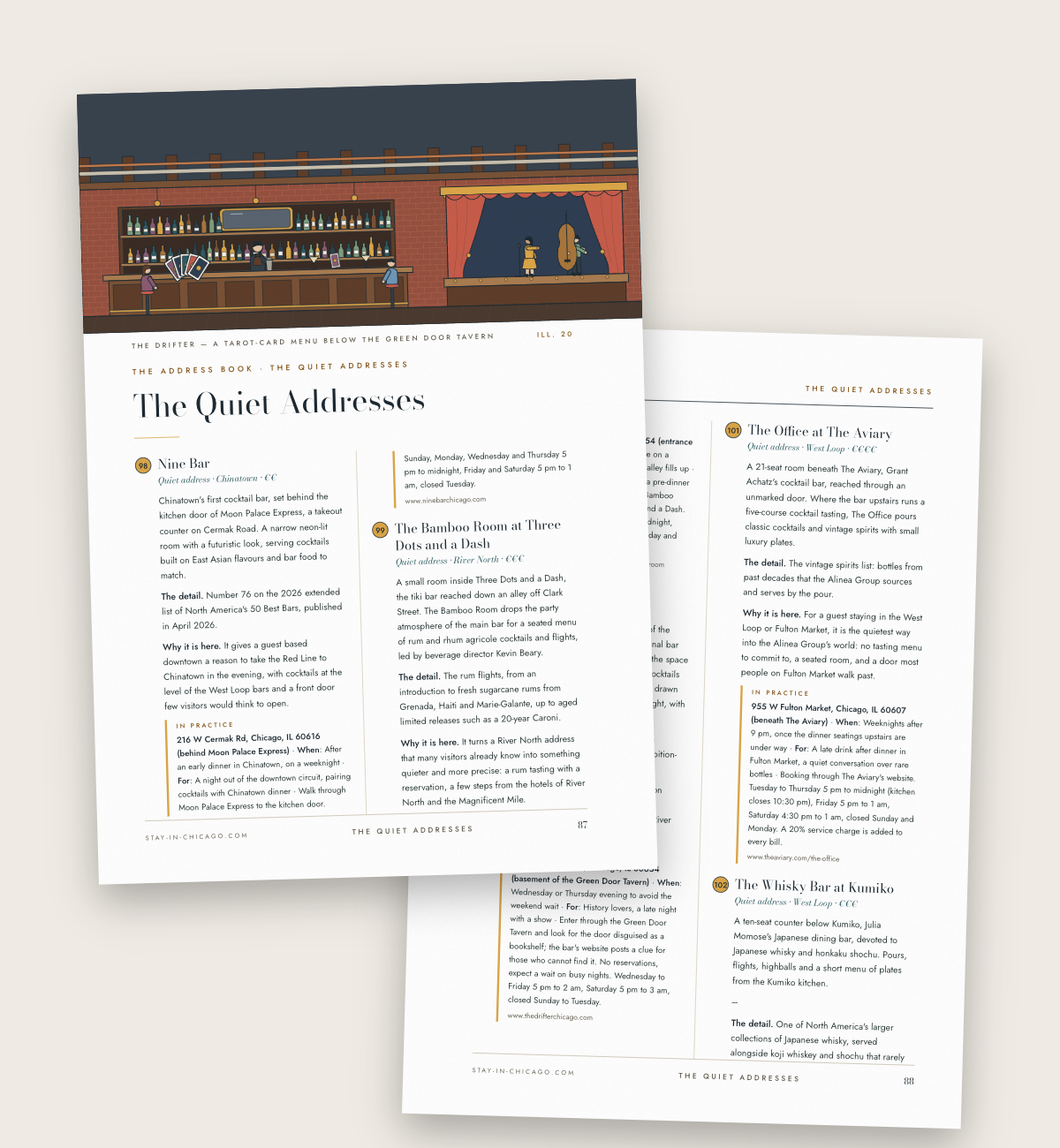
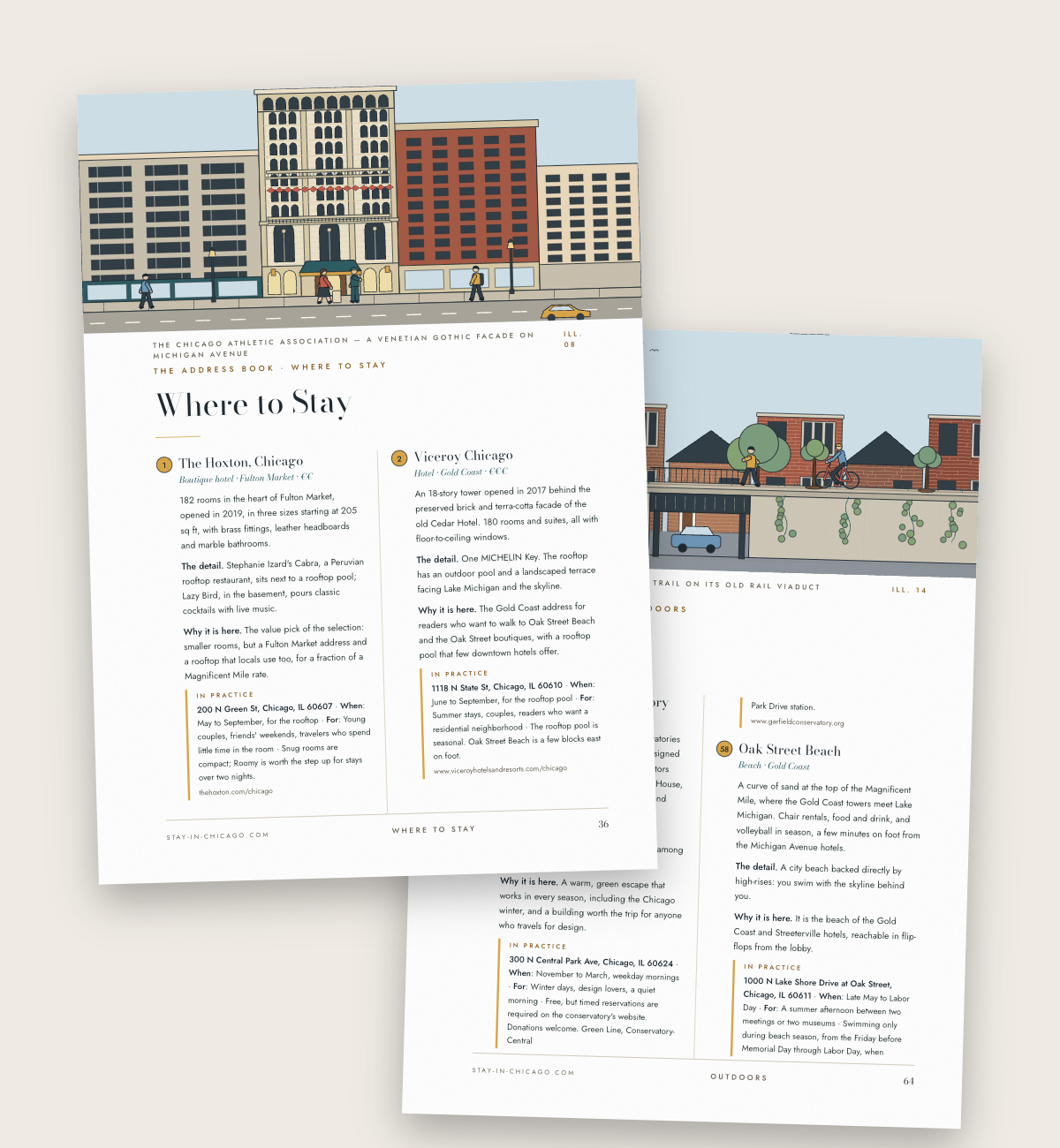
Each entry carries its number, its territory, a detail that sets it apart, one line on why it made the book and a practical block: where, when, for whom.
The Drifter, one of the quiet addresses, is there for its history. It is a 1920s speakeasy in the basement of the Green Door Tavern, kept with its original bar counter, back bar and stage because the space served as a storeroom for decades. The cocktails are listed on tarot cards, drawn each night from a deck of more than 100. The guide says how to find the door disguised as a bookshelf, and which evenings avoid the wait.
Three itineraries, from one day to five
Three routes built only from addresses in the guide, checked against their opening days. In Chicago the calendar decides more than the map: the Art Institute closes on Tuesdays, Smyth serves Wednesday to Saturday, and the architecture boats sail from March 15 to November 23 in 2026.
One day in the Loop and on the river, on foot, on a Thursday, from the Chicago Athletic Association. Cloud Gate before 8, when the plaza is almost empty. The Rookery, the Art Institute at opening, the architecture cruise aboard First Lady, Cindy's Rooftop at sunset and a late show at Andy's Jazz Club.
A weekend across three neighborhoods, Friday to Sunday, from a hotel in the West Loop. Kasama's daytime counter at 9 am on Friday, dinner at Smyth on the earliest seating. Green City Market on Saturday morning, The Spice House in Old Town, The Second City in the evening.
Five days from the Loop to Oak Park, Wednesday to Sunday, from The Langham or The Peninsula. The Field Museum on an early-access tour, the Robie House in Hyde Park, The 606 through Wicker Park and Bucktown, and a last morning at the Frank Lloyd Wright Home and Studio, reached by the Green Line.
Written for the way Chicago really works
Temperatures are in Fahrenheit, and the guide is plain about money and weather. It gives the average hotel rate month by month, $127 a night in January against $319 in June, when summer weather stacks on top of the big trade shows at McCormick Place. It explains that the combined tax on a large downtown hotel has been close to 19 percent since May 2026, and advises comparing hotels on the total, not the nightly rate. It notes that the Blue Line reaches downtown from O'Hare in 40 to 45 minutes for $5. And it dates the weekends that fill the city, from the Chicago Marathon on October 11 to Open House Chicago on October 17 and 18, 2026.
When to read it
Before you book rather than after. In Chicago the side of the river you sleep on shapes the trip more than the hotel does, and the guide says, territory by territory, who each one suits. Its page gives access to the download. It opens in the browser, and it is free.